The best clothing colors for blonde hair, blue eyes and fair skin depend less on a fixed list than on the blonde you actually have. Pale ash blonde, honey blonde and a deeper beige blonde create different levels of contrast around the face. Your natural roots, brows and the way the colour reflects light matter too. Start with the hair, then use clothing as a close-up test. A soft blue may flatter one blonde and make another look grey, while navy can give a low-contrast blonde the definition it needs.
Start with the blonde you actually have
Look at the hair in daylight before choosing colours near the face. Is the blonde creamy, beige, ash, honey or slightly strawberry? You do not need a perfect undertone label. You need to notice the direction that is visible in ordinary light. A warm blonde often carries yellow, gold or peach reflection. A cooler blonde can look beige, smoky or almost silver. Neutral blonde may move between the two depending on the room.
Depth matters as much as warmth. Very pale blonde against fair skin creates a gentle, low-contrast frame. Darker roots or a medium blonde create a clearer boundary around the face. That changes how clothing behaves. A pale shirt can blend into light hair, which may look soft and intentional or simply leave the face without enough definition. A deeper colour can restore that edge without changing the hair.
Check the root before you judge a top. A grown-out root can make a warm blonde look cooler overall, while a bright face frame may pull the impression lighter. If the hair has highlights, consider the mix rather than one strand. Clothing that works with the mid-lengths may fight with a pale front section. The neckline is close enough to show this interaction, especially in photographs.
Keep your usual hair finish in mind. Glossy straight hair reflects a top differently from matte waves or loose curls. A gold-beige blonde can look warmer when the hair is smooth and brighter when the same hair is textured. This is why a colour that looked good in a shop mirror may feel different in a phone photograph. Test the garment with the style you will actually wear.
How eye colour and hair contrast affect clothing
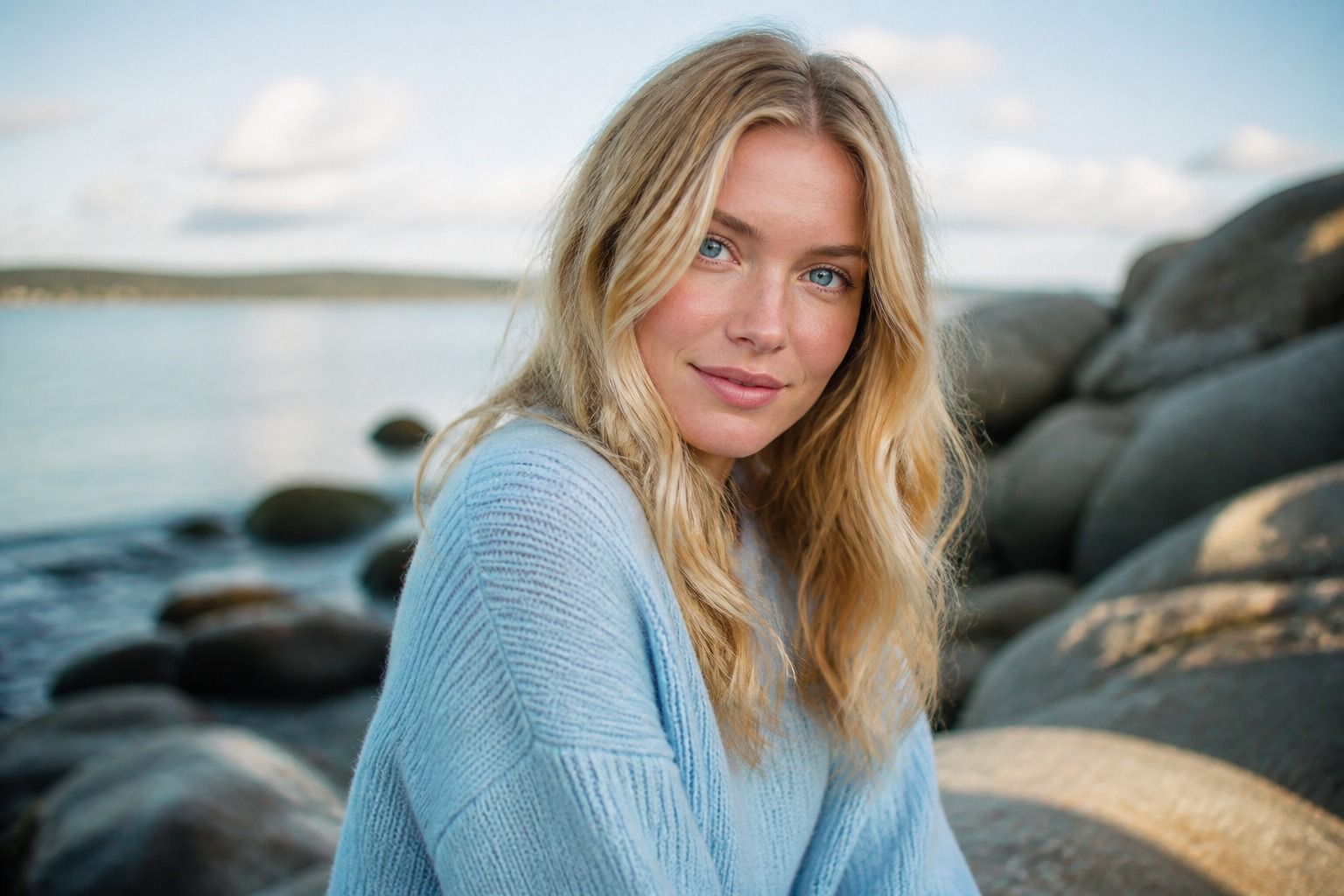
Blue eyes can pick up nearby blue, grey, green or violet, but the effect depends on the depth and clarity of the blue. A very pale eye beside pale blonde hair may benefit from medium contrast, such as a muted navy or a clear denim blue. A deeper blue eye can hold a darker top without the face disappearing. Fair skin adds another variable because the colour near the neckline can reflect upwards and change the overall balance.
Contrast is the relationship between your lightest and darkest visible features. Hair, brows, eyes, skin and clothing all join the picture. Someone with pale blonde hair, light brows and soft blue eyes may feel best in gentle colour changes. Someone with the same skin and eyes but a dark root and defined brows may carry charcoal, ink navy or a strong berry pink with more ease. The listed features are similar; the contrast is not.
Hair undertone can also compete with the eyes. A yellow-gold blonde next to a very cool blue top may make the hair look more yellow by comparison. That is not automatically bad. It may be the contrast you want. If the aim is a quieter look, try a softened blue or a blue with a little grey. The goal is to see the whole face, rather than forcing the hair and clothing into one temperature.
Brows are easy to forget when people discuss blonde hair. If the brows are naturally medium brown, a pale icy top may leave a strong dark point at the centre of the face. If the brows are very light, a black or deep navy neckline may become the loudest feature. Neither situation means the colour is wrong. It tells you where the eye lands first and whether that matches the look you intended.
Compare pale, medium and deep colours near the face
Pale colours can be excellent with fair skin when their surface has enough difference from the hair. Soft blue, cool pink, pale lavender and a light denim can echo blue eyes without making the face look drained. Compare the fabric with the hair at the temple, not only against the hand. A pale top may work when the blonde is darker or warmer, then disappear beside an almost-white ash blonde.
Medium colours give you a useful middle test. Dusty blue, muted teal, rose, berry pink and medium grey often show whether your hair needs softness or definition. A neutral blonde may look polished beside a quiet rose, while a warmer blonde may need a slightly warmer pink or a softened coral. Watch the hair reflection. If the colour makes the blonde look unexpectedly yellow, it may be too cool or too saturated for the particular shade.
Deep colours are not off limits for fair skin. Navy and charcoal can frame pale blonde hair with a clean edge, especially when the roots or brows provide some depth already. Dark brown may work better with honey or beige blonde than with a very icy blonde, where the contrast can feel abrupt. Try the same garment with different necklines before rejecting it. A high collar puts more colour close to the face than an open shirt.
| Colour near the face | When it may help | What to check with your hair |
|---|---|---|
| Soft blue | Echoes blue eyes without a hard contrast | Does it keep an ash blonde fresh or make a warm blonde look yellow? |
| Navy | Adds definition around pale blonde hair | Do the roots and brows balance the darker edge? |
| Cool pink | Brings colour near a neutral or cool blonde | Does the face stay lively, or does the hair look dull beside it? |
| Cream | Softens a strong light-dark jump | Does it blend with beige or honey tones too closely? |
| Charcoal | Gives a gentle alternative to black | Is the contrast useful, or does it make very pale hair feel flat? |
Use the table as a set of tests, not as a verdict. Fabric, light and the exact hair colour can change the result. A soft blue knit and a shiny blue shirt do not reflect the same way. A charcoal wool top can look quiet, while charcoal satin can look much sharper. Texture is part of the colour decision.
When cream works better than stark white
White is often treated as a simple choice for fair skin, yet the difference between stark white and cream can be obvious around blonde hair. Bright white creates a clear, cool edge. That can look crisp with an icy or neutral blonde and defined brows. It can also make very pale hair and fair skin merge into one light area, particularly under an overcast window or strong indoor lighting.
Cream lowers the contrast and brings a warmer reflection near the face. It can sit comfortably beside honey, beige and golden blonde, though a very yellow cream may make already-warm hair look more yellow. Try ivory, oatmeal and soft ecru rather than assuming every cream behaves the same. Hold the fabric below the chin and check the hair at the sides. If the face becomes calmer but the hair loses clarity, add contrast elsewhere with a darker brow, necklace or jacket.
Cool blonde can wear cream too, but the surrounding colours matter. A cool beige jacket over an ivory top may look more balanced than a warm tan directly under the chin. A small silver or pale gold detail can change the read without taking over. Metallics are useful here because they connect the neckline to the hair reflection. Silver tends to sharpen a cool blonde; pale gold can repeat the warmth in honey or strawberry tones. Treat that as a styling choice, not a rule about what you are allowed to wear.
Photograph the test in the light where you make clothing decisions. Department-store lighting can be very flattering or very strange, and a phone may correct the white balance after you take the picture. Look at the garment in daylight, then at a normal indoor light. If the hair only works with the top under one lamp, it is worth testing another shade in the same family.
Use clothing tests to refine a hair-colour decision
Clothing can help when you are deciding whether to change your hair, not only after the colour appointment. Take a plain front-facing photo in a neutral top, then compare two or three necklines in colours you already own. Keep the camera, distance and light steady. You are looking for patterns: does a deeper top make your current blonde look more balanced, or does it make the hair feel too pale? Does a soft blue bring out the eyes, or does it expose too much yellow in the hair?
Test the colour beside your actual hair, including the roots. If you are considering a cooler blonde, hold a cool pink or softened navy near the face. If you are thinking about warmer beige or honey, compare cream, muted teal or a gentle warm rose. This will not predict the dye result. It shows which direction gives you the contrast and softness you want from your everyday wardrobe.
Neckline and distance matter. A crew neck places the fabric close to the jaw and can make a small undertone difference look large. An open neckline leaves more skin between the hair and the garment. A scarf sits higher and may create the strongest test. When a colour feels wrong, move it away from the face before discarding it. The issue may be placement rather than the colour itself.
Save the useful observations in plain language. You might write, navy gives my pale blonde a better edge, cream works when the blonde is warm but not when the roots are very light, or cool pink looks good with the eyes but makes the ends look grey. Those notes are more helpful than a broad identity label. They can also guide a salon conversation about undertone, brightness and the amount of contrast you want to keep.
Hair colour and clothing should support each other without becoming a uniform. Blonde hair, blue eyes and fair skin can sit beside soft blue, navy, cool pink, cream or charcoal, but the right version depends on depth, undertone, texture and light. Compare the garment near the hair, check the roots and brows, and notice what happens in ordinary daylight. The best choice is the one that makes your actual colour look intentional while leaving you room to wear the rest of your wardrobe.